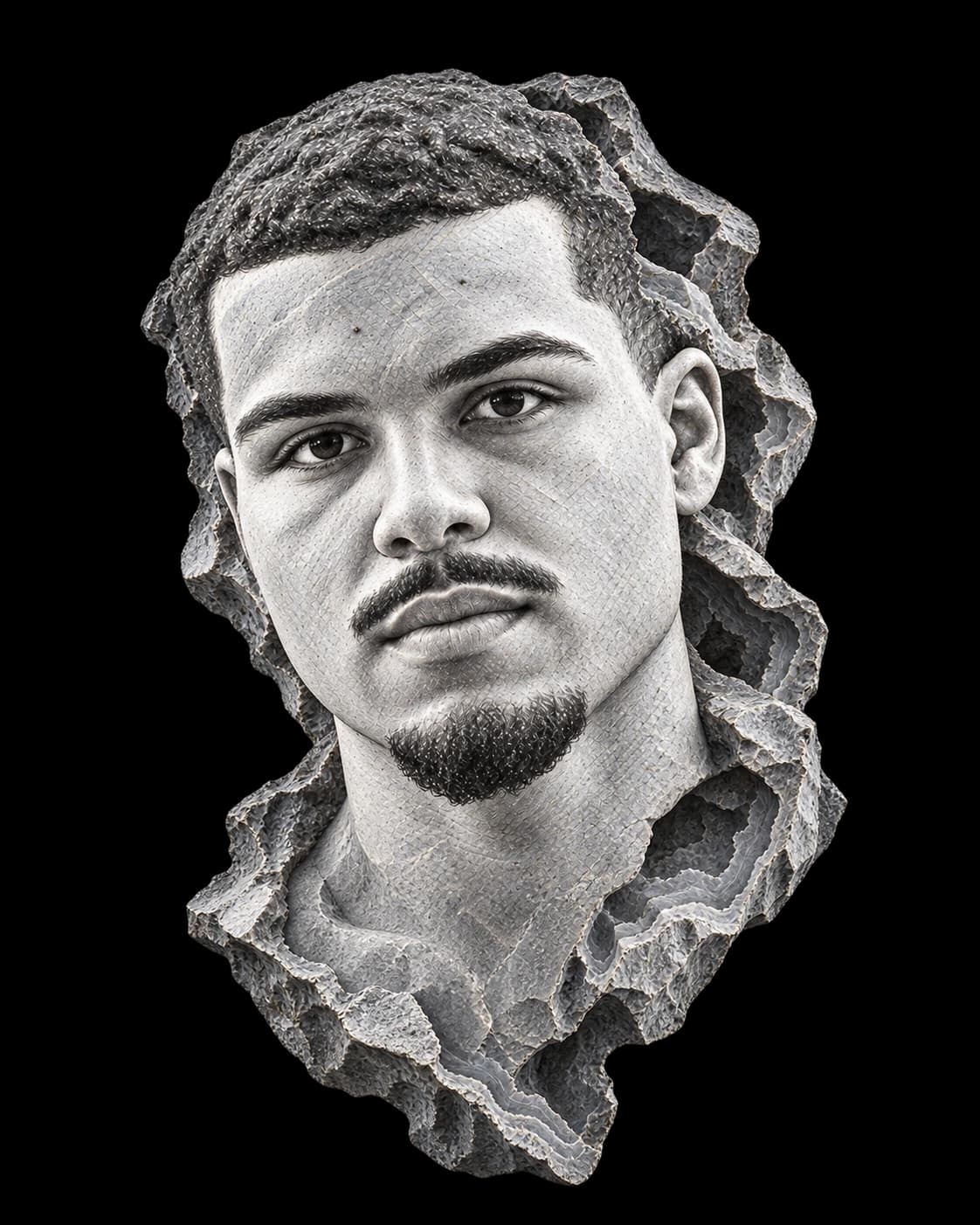
A few words about my journey
Discovering computer science
Discovering computing was a turning point in my path. What began as a hobby gradually took on another meaning: I wanted to understand how things worked and learn to build them myself. That interest gave me a direction. After an STMG baccalaureate, I chose computing to turn that curiosity into practice.
Lay the foundations
The BTS SIO programme in IT services at Lycée Saint-Gabriel helped me structure that learning. I laid the first foundations of my path and came to enjoy progressing through projects. That way of learning has stayed with me: try, encounter a difficulty, work to understand it, then try again with a little more perspective. As I progressed, the desire to go further grew.
A passion for AI
That led me to the Bachelor’s programme in AI & Big Data at ESGI, from 2023 to 2024, followed by the Mastère programme in the same field, from 2024 to 2026. Artificial intelligence became a passion. Training a model from data interested me, but the questions behind it drew me in even more: how does it learn? What does it retain from experience? Why does it succeed in some situations and fail in others?
Those questions brought me back to mathematics, probability and optimisation. My education did not begin with a focus on those disciplines; I learned to deepen them by connecting them to problems I encountered. A concept becomes much more tangible when I can observe its effects, visualise it or implement it. Gradually, reading and experiments went beyond the coursework. A day devoted to learning and graphs at the Institut Henri Poincaré, for instance, inspired me to follow a course on graph neural networks.
Learning from the field
Alongside my studies, professional experience gave the work a concrete setting. An internship at 40° sur la Banquise in 2024 led me to design a RAG document assistant. Then, during two years as a work-study Data Scientist at La Poste, I worked on territorial data, decision-support analyses and a secure internal assistant. I discovered the demands of using a model in practice: understanding the data, explaining an answer and accounting for its limits. Moving between the classroom and the field made me want to understand more deeply what I was building.
Seek to understand
That desire also took shape in my personal projects. With DeepLearn, I wanted to make scientific papers more accessible and give experimentation more room. Explaining a mechanism to someone else makes me clarify my own understanding. Sharing knowledge is therefore part of how I learn, alongside coding and reading.
The NASA Space Apps Challenge marked another step in my thinking. While working on exoplanet detection from light curves, I became interested in how a model could use physical knowledge and express uncertainty in its predictions. My reinforcement learning projects extended those questions. In Quarto, an agent could perform well, then prove fragile against a very simple strategy. The gap between performance and apparent understanding was striking: I wanted to know what it had really learned and what it lacked to adapt.
Moving towards research
That is where my interest in research stands today. From discovering computing to studying models, curiosity about what lies behind a result has been the common thread. I now want to strengthen my theoretical foundations and prepare for a PhD on learning and generalisation, particularly in reinforcement learning. One question guides me: how can external knowledge, whether documentary or structured, help an agent explore, reason and adapt? My project is still taking shape through reading and experiments, but the direction is clear: spend more time understanding these mechanisms and contribute to AI research.